
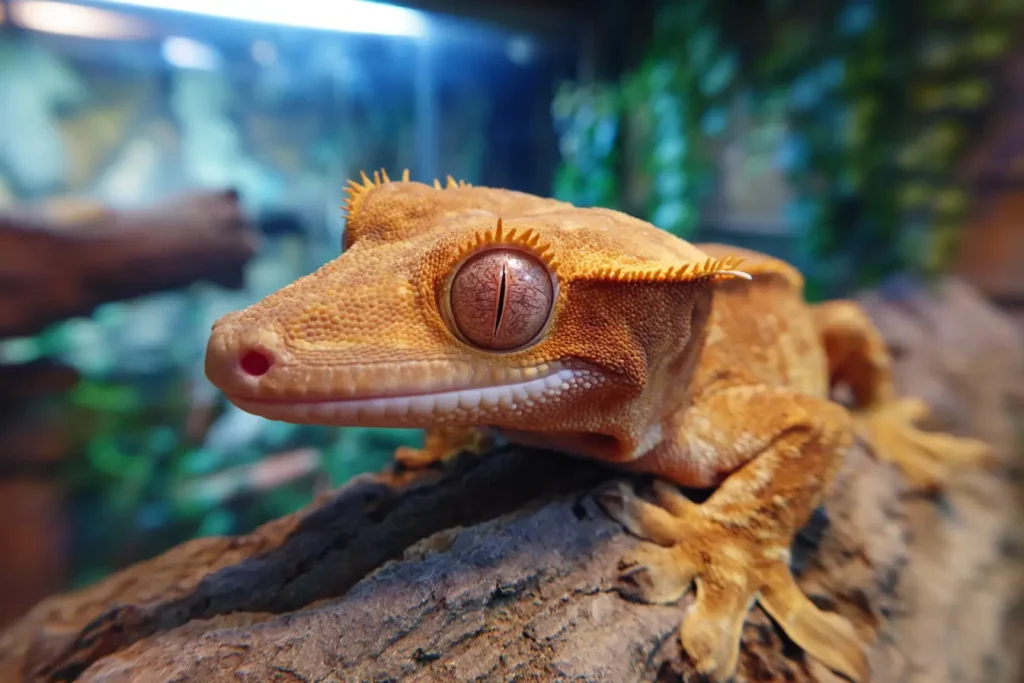
If you are choosing your very first reptile, it is hard to do better than a crested gecko. They are small, quiet, happy at ordinary room temperature, and forgiving of the little mistakes every new keeper makes. A well cared for “crestie” can live fifteen to twenty years, so the enclosure you set up this weekend is really the start of a long relationship. This guide walks you through everything you need — housing, heating, humidity, food, handling and the health problems worth knowing about — in plain language, with no assumptions about what you already know.
Crested geckos (Correlophus ciliatus) come from the rainforests of New Caledonia, a cluster of islands off the coast of Australia. For decades they were believed extinct, until a small population was rediscovered in 1994. Almost every crestie in the hobby today descends from those wild animals, which means the pet you buy is captive-bred, well established, and never taken from the wild. They are arboreal, meaning they live up in the branches rather than on the ground, and crepuscular, meaning they come alive at dawn and dusk. Understanding those two words explains most of what follows.
Are crested geckos good for beginners?
In short, yes — and for good reasons rather than lazy ones. Unlike bearded dragons or many other popular lizards, crested geckos do not need a basking bulb pushing 35°C, and they do not strictly require UVB lighting to survive, because their staple food already contains the vitamin D3 they need. They thrive at the sort of temperature you keep your living room, they eat a prepared powder you mix with water, and they tolerate gentle handling once they have settled in. A single adult is comfortable in an enclosure that fits neatly on a shelf.
None of that makes them disposable or “low effort” pets, though. They need daily misting, fresh food several times a week, and an environment that holds the right humidity. What makes them beginner-friendly is that the margin for error is wide: get the basics roughly right and your gecko will do well while you learn the finer points. This guide is about getting those basics genuinely right the first time.
Your crested gecko at a glance
Before we dig into each topic, here is the quick reference you will find yourself coming back to. Print it, screenshot it, stick it near the enclosure — whatever helps.
| What | The short answer |
|---|---|
| Adult size | Around 11–14 cm nose to tail, 35–55 g in weight |
| Lifespan | 15–20 years with good care |
| Enclosure (one adult) | Minimum 45 × 45 × 60 cm, taller than it is wide |
| Daytime temperature | 22–26 C (72–78 F); never above 28 C for long |
| Night-time temperature | A natural drop to 18–22 C is welcome |
| Humidity | Spikes to ~80% after misting, dries to 50–60% before the next |
| Staple food | Commercial crested gecko diet (powder mixed with water) |
| Handling | Short, calm sessions once settled; never grab the tail |
What you’ll need before your gecko comes home
The single most common mistake new keepers make is buying the animal first and the equipment second. Set the enclosure up a week early, get it running, and watch the thermometer and hygrometer settle before your gecko ever arrives. That way you are moving a healthy animal into a stable home rather than troubleshooting on the fly.
Here is the honest shopping list — the only list of bullet points you really need in this whole guide:
- A tall, front-opening arboreal vivarium or glass terrarium of at least 45 × 45 × 60 cm
- A digital thermometer and hygrometer (guessing is how humidity problems start)
- Branches, cork bark and plenty of foliage — real or artificial — for climbing and cover
- Substrate: paper towel for a nervous new arrival, or a bioactive soil mix for a planted setup
- A shallow water dish and a couple of small ledge dishes for food
- A hand mister or pump sprayer, and a tub of your chosen crested gecko diet
Notice what is not on that list: a basking lamp, a heat mat stuck to the glass, or a powerful UVB unit. We will come to why in a moment.
The right enclosure: why vertical matters
Because crested geckos are arboreal, height matters far more than floor space. A tank that is wide and shallow, however large, largely wastes its volume on an animal that wants to climb. Aim for an enclosure that is taller than it is wide. For a single adult, 45 × 45 × 60 cm is the sensible minimum, and bigger is genuinely better — more room means more plants, more climbing routes, and a humidity level that stays stable rather than swinging with every mist.
There is one exception that surprises people. A tiny hatchling in a huge enclosure can actually struggle: it may fail to find its food, and the empty space can leave it stressed and skittish. Many keepers start babies in a smaller tub or a modest terrarium and “grow them up” into the full-size enclosure once they pass roughly 12 g. If you are buying a young gecko, ask the breeder how it has been housed and match that at first.
Fill the space generously. Cork bark rounds and flats, a lattice of branches at different angles, and a curtain of leaves give your gecko the sense of security a rainforest animal needs. A large piece of cork bark leant against the back wall doubles as a hide and a favourite sleeping spot. Sparse enclosures make for shy, stressed geckos; cluttered ones make for bold, visible ones.
Keeper’s tip: Give your gecko at least one broad, near-vertical surface it can rest flat against — a wide slab of cork bark is perfect. Young geckos that only ever cling to glass or hang from the mesh lid can develop a kinked tail over time, a problem we will return to under health.
Temperature: cooler than you think
This is where crested geckos differ most from the reptiles you may have read about. They are a cool-climate forest species and they genuinely prefer ordinary room temperature: 22–26 C (72–78 F) through the day, with a natural dip at night that they actively enjoy. In most homes for most of the year, that means you need no supplementary heating at all.
Heat is far more dangerous to a crestie than cold. Sustained temperatures above about 28 C (82 F) cause real stress, and prolonged exposure to the low thirties can be fatal. If your room reliably drops below the high teens in winter, a gently controlled heat source — ideally a radiant heat projector rather than a hot spotlight — can take the edge off. Crucially, run anything that produces heat through a thermostat so it can never overshoot, and place it so the gecko cannot climb against it. Far more often, the summer problem is keeping the enclosure cool, not warm.
Humidity: the rhythm that keeps them healthy
Humidity is the part new keepers most often get wrong, usually by aiming for “high humidity” and keeping the enclosure permanently soggy. What a crested gecko actually wants is a cycle. Mist the enclosure thoroughly in the evening so the humidity climbs to around 80%, then let it dry back down to 50–60% over the following hours before you mist again, typically the next morning. That wet-then-dry rhythm mimics rainforest nights and mornings, gives your gecko droplets to drink, and — just as importantly — lets everything dry out enough to stop mould and bacteria taking hold.
A cheap digital hygrometer takes all the guesswork out of this. If the reading never drops below 70%, you are misting too much or your ventilation is poor; if it is dry within an hour, mist a little more or add live plants to hold moisture. Live plants, a layer of leaf litter, and a good substrate all act as humidity buffers, which is one reason a bioactive setup is so popular for this species. If you would like to go that route, our companion guide on setting up a bioactive terrarium walks through the drainage layer, substrate and planting step by step.
Do crested geckos need UVB lighting?
You will find keepers on both sides of this, so let us be straight about it. Crested geckos can live long, healthy lives without UVB, because a good commercial diet already supplies vitamin D3. For years that was the standard advice, and it is not wrong.
The current thinking, though, is that a low level of UVB is a genuine benefit rather than a requirement. A dim, forest-grade UVB source — something like a low-percentage T5 UVB kit designed for shade-dwelling species — supports natural behaviour, can improve colour and activity, and gives you a safety margin on vitamin D. The key word is low. These are crepuscular animals with sensitive eyes, so you want a weak output, plenty of leafy cover to retreat into, and a simple day-night cycle of roughly six to eight hours on. Replace the bulb every six to twelve months, as UV output fades long before the light looks dimmer to us. If you do add UVB, you can ease off on dietary supplements slightly; if you do not, make sure your diet and any dusted insects are covering the D3 for you.
Substrate: bioactive or paper towel?
Both are valid, and the right choice depends on your gecko’s age and your appetite for a project. Paper towel is unbeatable for a brand-new or very young gecko: it is cheap, you can see exactly what the animal is eating and passing, and there is zero risk of it swallowing loose material. Many keepers run babies on paper towel until they are established, then graduate them to something naturalistic.
A bioactive substrate — a moisture-holding soil blend topped with leaf litter and a living clean-up crew of isopods and springtails — turns the enclosure into a small self-cleaning ecosystem. The clean-up crew breaks down waste and shed skin, the substrate holds humidity between mistings, and live plants finish the picture. It is more work up front and slightly more forgiving of neglect afterwards. Our guides on keeping isopods as a clean-up crew and building a bioactive terrarium cover the details if you decide to go that way.
What do crested geckos eat?
Here is the good news that sells so many people on this species: the bulk of a crested gecko’s diet comes out of a tub. Commercial crested gecko diets — complete powders you mix with water into a smooth paste — are formulated with the right balance of fruit, protein, calcium and vitamins. You offer a small amount in a shallow dish a few times a week, and that alone can keep a gecko in excellent condition for its whole life. The well-known brands (Pangea and Repashy are the two you will hear most) differ mainly in flavour and texture; it is worth trying a couple to see which your gecko prefers, as they can be surprisingly opinionated.
How often depends on age. Hatchlings and juveniles are growing fast and do best fed most days; adults settle into a rhythm of roughly three feeds a week. Mix only what you need, offer it fresh, and remove the dish within about a day — prepared diet spoils quickly in a warm, humid enclosure, and mouldy food is a genuine hazard.
Insects are the enrichment on top of that staple, not a replacement for it. A weekly treat of appropriately sized crickets or small dubia roaches gives your gecko something to hunt and adds variety. Two rules keep insect feeding safe: nothing longer than the width of your gecko’s head, to avoid choking or impaction; and dust the insects with a calcium supplement first, especially if you are not using UVB. For more on raising and preparing livefood properly, see our guide to gut-loading and dusting feeder insects. Always keep a shallow dish of clean water available too, even though much of their hydration comes from droplets on the leaves after misting.
Handling and taming your crested gecko
Resist the urge to handle a new gecko straight away. Moving home is stressful for a small animal, and the kindest thing you can do in the first two to three weeks is leave it alone to eat, explore at night, and learn that its enclosure is safe. Once it is feeding reliably and no longer bolting when you open the door, you can begin.
Go slowly and let the gecko come to you rather than snatching at it. The classic technique is “hand-walking”: let it step onto one open hand, then place the other in front so it walks from palm to palm. Keep early sessions to just a few minutes and build up gradually. Ten to fifteen minutes is plenty for a confident adult, and some individuals simply never love it — that is fine, and forcing it only sets you back.
Keeper’s tip: Never, ever pick a crested gecko up by its tail. Like many geckos they can “drop” the tail to escape a predator — and unlike leopard geckos, a crestie’s tail does not grow back. A tailless gecko is perfectly healthy and lives a normal life, but it is a startling thing to cause by accident.
Expect the occasional leap. Crested geckos are astonishing jumpers, so handle them low over a bed or sofa, in a room with the doors shut and no curious cat or dog around. And save handling for the evening when they are naturally awake; hauling one out of a dead sleep at midday is the reptile equivalent of being woken at 3am.
Common health problems (and how to avoid them)
Almost every health issue a pet crested gecko runs into traces back to one of three things: humidity that is wrong, calcium or vitamin D3 that is missing, or a hazard in the enclosure. Get those right and you have prevented the vast majority of problems before they start. Here are the ones worth recognising.
Metabolic bone disease
Metabolic bone disease (MBD) is the big one, and it is almost entirely preventable. It develops when a gecko does not get enough calcium and vitamin D3, and the body starts drawing calcium out of the bones to compensate. The bones become soft and bendy; you may see swollen or wonky limbs, a rubbery lower jaw, a kinked spine, tremors, or a gecko that struggles to climb and grip. Prevention is simple: feed a good complete diet, dust feeder insects with calcium, and consider low-level UVB. Suspected MBD is a vet visit, not a wait-and-see — caught early it can often be turned around.
Floppy tail syndrome
Floppy tail syndrome (FTS) is when the tail flops over the hips at an odd angle, sometimes dragging the base of the spine with it. Much of it is thought to come from young geckos spending too long hanging head-down on glass or mesh with nowhere flat to rest, so gravity slowly works on the developing tail. The fix is preventative and cheap: give plenty of broad, near-vertical resting surfaces — cork bark, wide branches, sturdy leaves — rather than an enclosure the gecko can only cling to by the walls. Some cases have a genetic component, which is one reason reputable breeders avoid pairing affected animals.
Stuck shed and impaction
Crested geckos shed regularly, and a healthy shed comes away in one or two clean pieces (they usually eat it). Trouble comes when humidity has been too low: fragments of old skin cling around the toes, tail tip, and eyes. Retained shed is not just cosmetic — a band of dried skin around a toe can cut off circulation and cost the gecko the toe. A proper humidity cycle prevents most of it; if you spot stuck shed, a session in a warm, humid tub usually softens it enough to come away gently. Impaction — a blockage from swallowed substrate or an over-large insect — is likewise a prevention story: keep young geckos on paper towel, size feeders sensibly, and remove uneaten insects.
When to call a vet: a gecko that stops eating for more than a week or two, loses noticeable weight, sits limp or unusually pale, struggles to grip or climb, or develops swellings or a stuck shed you cannot safely remove. Find an exotics-friendly vet before you need one — it saves precious time in an emergency.
Bringing your gecko home: the first fortnight
The last piece of the puzzle is patience. When your gecko arrives, place it gently into its ready-and-waiting enclosure and then, as hard as it is, mostly leave it be. Mist and feed on schedule, but keep the traffic and noise down and let it find its confidence. It is completely normal for a new crestie to hide all day, skip a meal or two, and only creep out to explore once the lights are off. Within a couple of weeks you should see it settling into a routine, greeting the evening mist, and taking food reliably — that is your green light to begin gentle handling.
Do that, and you have the makings of a two-decade companionship with one of the most rewarding little animals in the hobby. If you are ready to start, our captive-bred crested geckos and everything mentioned in this guide are waiting in the shop.
Frequently asked questions
How often should I mist my crested gecko’s enclosure?
Usually once or twice a day — a heavier misting in the evening and, if needed, a lighter one in the morning. The goal is a spike to around 80% humidity that then dries back to 50–60% before the next misting, rather than a permanently wet enclosure. Let your hygrometer, not the clock, be the final judge.
Do crested geckos need a heat lamp?
Usually not. They are comfortable at normal room temperature (22–26 C) and are far more at risk from overheating than from being slightly cool. Only add gentle, thermostatically controlled heat if your room regularly drops below the high teens, and never use a fierce basking spotlight.
Can crested geckos live together?
It is safest to keep them singly. Two males will fight, and a male and female housed together will breed relentlessly, which is hard on the female. Even two females can bully one another over food and space. As a beginner, one gecko per enclosure is the simplest and kindest rule.
What’s the best food for a crested gecko?
A complete commercial crested gecko diet — a powder you mix with water — should be the staple, offered a few times a week, with the occasional dusted insect for variety. Popular, well-formulated brands include Pangea and Repashy; try a couple of flavours to see which your gecko prefers.
Why won’t my crested gecko eat?
A newly homed gecko often skips meals for a week or two while it settles — that alone is rarely cause for alarm. Beyond that, the usual culprits are an enclosure that is too warm, humidity that is too low, a flavour of diet it dislikes, or simple stress. Check your temperatures and hygrometer first, try a different flavour, and if a healthy adult refuses food for more than a couple of weeks or starts losing weight, see an exotics vet.
How long do crested geckos live?
With good husbandry, commonly 15 to 20 years. That longevity is exactly why it is worth setting the enclosure up properly from the start — you are not buying a pet for a season, you are setting up a home for the better part of two decades.